
The Hidden Problem in Real Estate — and How OwlDoor Is Fixing It
# The Hidden Problem in Real Estate — and How OwlDoor Is Fixing It
Most industries do not see 15 to 20 percent of their workforce change companies every year.
Real estate does.
According to OwlDoor founder Darren Johnson, that is not a coincidence. It is a symptom.
"Agents are not failing because they are bad. They are failing because they are in the wrong environment."
That belief led to the creation of OwlDoor, a platform designed to match real estate professionals with the right opportunities, not just more opportunities.
From Lead Chaos to Precision Matching
Before OwlDoor, Johnson helped generate and sell millions of real estate leads through his company AgentZip, working with major platforms such as Realtor.com, OpCity, and Homes.com.
What he discovered challenged a widely held assumption.
"The leads were not bad. They were being converted, just not by everyone."
Data consistently showed that roughly 20 percent of agents were converting the majority of opportunities. That pattern mirrors the evolution of platforms like Zillow, where programs such as Flex prioritize top-performing agents.
But Johnson saw a deeper issue.
"It is not just skill. It is fit."
The Real Problem: Misalignment
The real estate industry operates on a flawed premise that more agents, more leads, and more tools will drive growth.
OwlDoor takes the opposite approach. Instead of focusing on volume, it focuses on alignment.
The platform uses more than 100 data points to match agents with teams, including:
- Sales style
- Lead dependency versus self-generation
- Coaching versus independence preference
- Work environment (remote versus in-office)
- Leadership style and team structure
- Technology stack compatibility
"There is a formula to this. The right agent on the wrong team will fail. The right agent on the right team becomes a top producer."
Inside the AI Match System
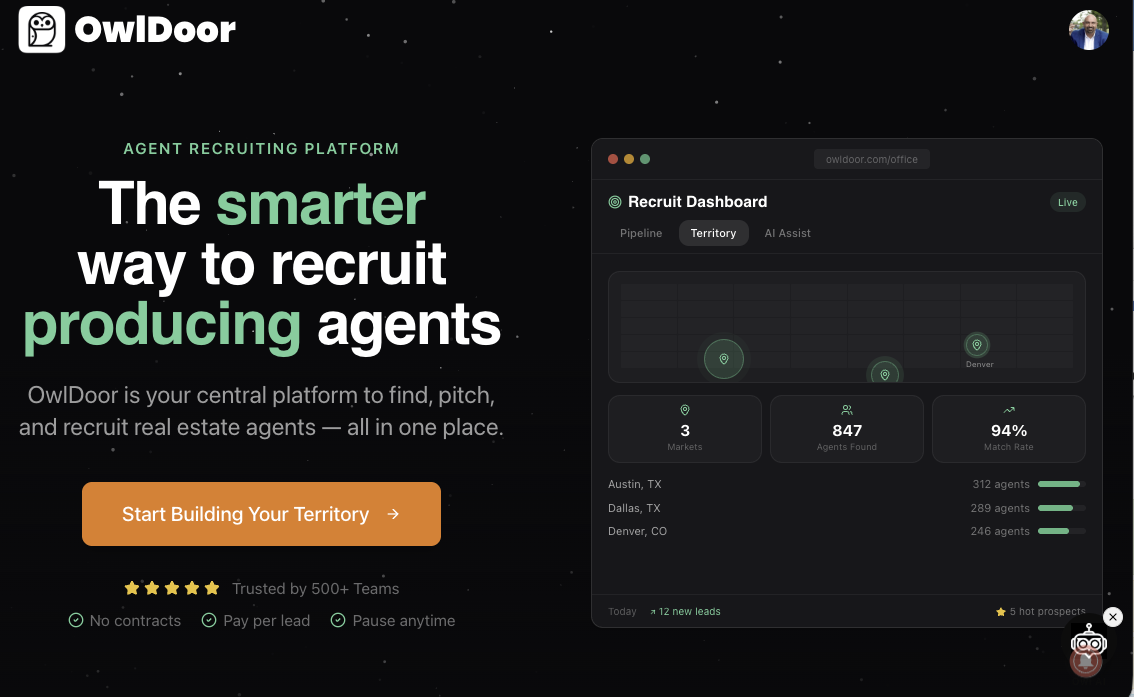
OwlDoor's matching engine begins with a guided process in which agents and teams define what they actually need, not just what looks good on paper.
The goal is not to generate more conversations. It is to generate the right ones.
A Model Built on Performance
OwlDoor's business model is intentionally simple.
No contracts. Payment only occurs when a recruit is delivered.
"We do not need upfront fees. We have already used this system to help build some of the top teams in the country."
Several teams using the platform now rank among the top 100 nationwide out of tens of thousands.
This performance-based model contrasts with traditional recruiting approaches, which often rely on:
- Job boards filled with low-quality applicants
- Broad Facebook advertising campaigns
- CRM tools without execution
"We took what works from all of it and removed what does not."
🚀 Unmatched Conversion Rates Redefine Recruiting
One of OwlDoor's most significant differentiators is not just its technology, but its conversion performance.
Early client Jason Campbell, a team leader in San Antonio, Texas, has reported results that are rare in the industry. After approximately one year on the platform, Campbell received between 60 and 70 qualified agent leads and hired 57 of them.
"We are seeing nearly a 90 percent conversion rate. That is unheard of in this industry."
In an environment where traditional recruiting channels often struggle to convert even a small percentage of inbound interest, OwlDoor's results suggest a fundamentally different approach.
From Top of Funnel to Bottom Before First Contact
Unlike conventional platforms that deliver cold or unqualified leads, OwlDoor is designed to pre-sell and pre-qualify candidates before they ever reach a team leader.
The system combines:
- Direct outreach, including calls, texts, and email
- Strategic retargeting campaigns
- Structured positioning of each team's value proposition
By the time a candidate is introduced to a team:
- They understand the opportunity
- They have already been introduced to the team's strengths
- They have expressed real interest
This effectively moves candidates from the top of the funnel to the bottom before the first conversation takes place.
Built by Operators, Not Just Software
OwlDoor's strategy is rooted in real-world execution.
Johnson developed the system after helping scale one of the largest real estate teams in the United States, the Jason Mitchell Group, from outside the top 400 to number one nationwide, according to RealTrends rankings.
The same principles used to drive that growth, including direct response marketing, outbound prospecting, and conversion-focused messaging, are now embedded into OwlDoor's platform.
⚡ Turning Skeptics Into Partners
The platform's performance has also played a key role in attracting partners and investors.
Rather than relying on projections, Johnson encouraged early adopters to test the system directly.
"I told them, just try it."
The pattern that followed was consistent:
- Initial skepticism
- Hands-on testing
- Rapid validation through results
According to internal feedback, partners reported conversion rates they had not previously seen in recruiting environments.
The Unpopular Truth About Real Estate
Johnson is direct in his assessment of the industry.
"Eighty to ninety percent of agents probably should not be agents."
This is not framed as criticism of individuals, but as a structural issue.
Agents are expected to generate leads, follow up instantly, manage CRMs, convert deals, build relationships, and market themselves simultaneously.
"Most jobs require five responsibilities. This one requires thirty."
He believes the future will be more specialized:
- Technology will handle lead generation and appointment setting
- Agents will focus on relationships and closing
Who Adapts, Wins
If OwlDoor succeeds, it will not eliminate people. It will expose inefficiencies.
"The only people who lose are the ones who do not evolve."
As AI-driven outreach, automation, and data-driven matching become more common, agents and teams relying on outdated systems may struggle regardless of platform.
"We are not creating that shift. We are aligning people within it."
Beyond Recruiting
While OwlDoor begins with recruiting, its long-term vision extends further.
Johnson sees a missing layer in the industry: a true business-to-business identity system for real estate professionals.
"Agents have consumer profiles everywhere. There is no real platform where professionals evaluate and connect with each other."
OwlDoor is building toward:
- Agent-to-agent referral networks
- Agent and lender partnerships
- A performance-based professional ecosystem
A New Category
OwlDoor is not positioning itself as just another recruiting tool.
It is aiming to become an operating layer where teams discover talent, manage relationships, and run core parts of their business.
From Real Estate to the Future of Work
Long term, the company's ambition goes beyond real estate.
"We want to solve job matching based on how people actually work, not just what is on a résumé."
As AI continues to reshape the workforce, Johnson believes alignment between people, roles, and environments will become increasingly important.
"People should enjoy where they work and who they work with."
The Bottom Line
OwlDoor is not trying to create more agents. It is trying to create better alignment.
In real estate, success has never been only about effort. It has always been about being in the right place, with the right people, at the right time.
Learn more at OwlDoor.com.